CI/CD on Databricks: GitHub Actions, OIDC, and Asset-Bundle Deployment (2026)
A modern Databricks CI/CD pipeline has four properties: declarative deployment via Asset Bundles, OIDC-federated authentication (no PATs), multi-environment promotion with approval gates, and notebook integration tests that run on every PR. This is the practitioner-level walkthrough of how to assemble that pipeline.
Every team adopts CI/CD on Databricks the same way: they try to wire it up the way they did elsewhere, hit two specific issues, and rebuild from the ground up. The first issue is authentication, personal access tokens don't belong in a CI environment but they're the path of least resistance. The second is testing, notebooks aren't naturally testable. Both have clean solutions in 2026, and once you have them, the rest of the pipeline is straightforward.
OIDC federation: stop putting PATs in GitHub secrets
GitHub Actions can federate its workflow identity to Databricks via OAuth 2.0 token exchange. The
setup, done once per repo and environment: create an OAuth federation policy in your Databricks
account that trusts the specific GitHub workflow (by repository + workflow + branch), grant the
corresponding service principal the privileges it needs, and configure the workflow with
id-token: write. Every CI run receives a short-lived OAuth token, scoped to the SP,
issued only for that run. No secret in GitHub. No rotation. No quarterly audit nightmare.
The same pattern works on GitLab, CircleCI, and most modern CI platforms. The Databricks side is identical; only the federation policy's audience claim changes.
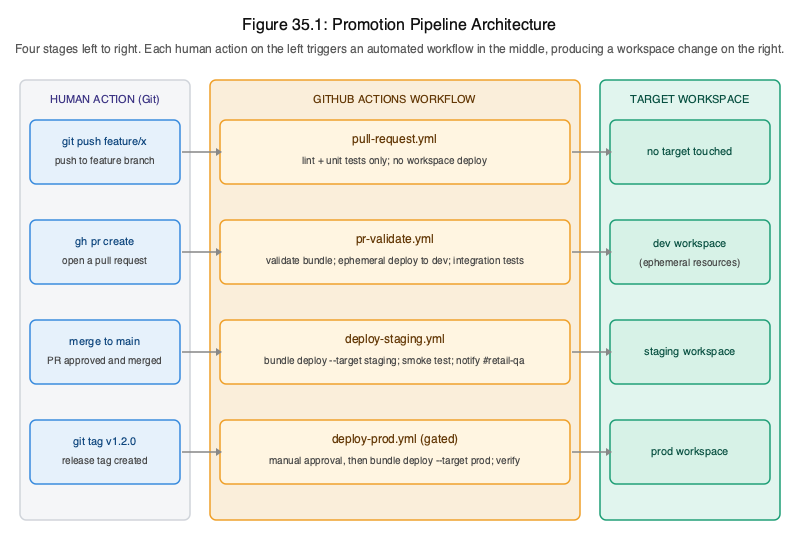
The pipeline shape
A typical workflow:
on:
  pull_request:
  push:
    branches: [main]

jobs:
  validate:
    permissions:
      id-token: write
    steps:
      - uses: actions/checkout@v4
      - uses: databricks/setup-cli@v0
      - run: databricks bundle validate -t dev
      - run: databricks bundle deploy -t dev
      - run: databricks bundle run integration_tests -t dev

  deploy_staging:
    if: github.ref == 'refs/heads/main'
    needs: validate
    environment: staging
    steps:
      - uses: actions/checkout@v4
      - uses: databricks/setup-cli@v0
      - run: databricks bundle deploy -t staging

  deploy_prod:
    if: github.ref == 'refs/heads/main'
    needs: deploy_staging
    environment: production   # gated by required reviewers
    steps:
      - uses: actions/checkout@v4
      - uses: databricks/setup-cli@v0
      - run: databricks bundle deploy -t prod
Same bundle, three targets, two gates (CI tests, manual prod approval). The promotion path is legible at a glance, which is what review and audit actually need.
Testing: unit, integration, contract
Unit tests: factor logic out of notebooks into Python modules under src/. Test them
with pytest in the standard way. The CI runs pytest on every PR, no Databricks workspace needed.
Integration tests: databricks bundle deploy -t ci deploys to a CI-specific target,
databricks bundle run integration_test_job -t ci triggers the test job, and a final
step asserts on the resulting tables or model registry entries. Each PR gets a clean, isolated
deployment.
Contract tests: SDP expectations double as data quality contracts. If a PR breaks the contract, the SDP pipeline fails its update; the CI sees the failure and blocks the merge. Quality enforcement happens where the data lives.
Environments: workspaces, catalogs, and SPs
The pattern that consistently holds up at scale:
- Separate workspaces for dev / staging / prod.
- Separate UC catalogs (
dev_retail,staging_retail,prod_retail) plus a globalshared_catalogfor cross-environment reference data. - One SP per environment per service, narrow grants, named after the workload they own.
- OIDC federation policies that grant only the specific SP each workflow needs.
The PR experience matters
A pipeline that takes 30 minutes to run on every PR is one nobody waits for. Cache the bundle deploy step (it's idempotent), parallelize the integration test job's tasks, and aim for a sub-10-minute total. The faster the loop, the more code people will trust the platform with.
What's in Volume 3 on this
Chapter 35 is the CI/CD chapter: OIDC federation setup end-to-end (GitHub side and Databricks side), the workflow template above expanded with caching and matrix strategies, the testing architecture, environment promotion patterns, and an opinionated rollback playbook. The foundation is Asset Bundles (Ch 34); everything else is wrapping that with the right gates.