RAG on Databricks: The 2026 Practitioner's Guide
Retrieval-augmented generation is the dominant pattern for production LLM systems in 2026. On Databricks, it converges around Mosaic AI Vector Search, Foundation Model APIs, and MLflow's evaluation tooling. This guide is the architecture, the operational mechanics, and the parts where teams keep getting it wrong.
Most teams shipping a Databricks RAG system in 2026 follow roughly the same architecture. Documents land in Delta tables. A pipeline chunks and embeds them. The chunks plus their embeddings land in a Mosaic AI Vector Search index. At query time, the user's question is embedded, the top-k chunks are retrieved, and a generation model, local or external , produces the answer. Tracing, evaluation, and monitoring run through MLflow.
The picture above is correct. It is also dangerously oversimplified. The interesting question is not "what does a RAG system look like", it's "what breaks at scale, and what does it cost?"
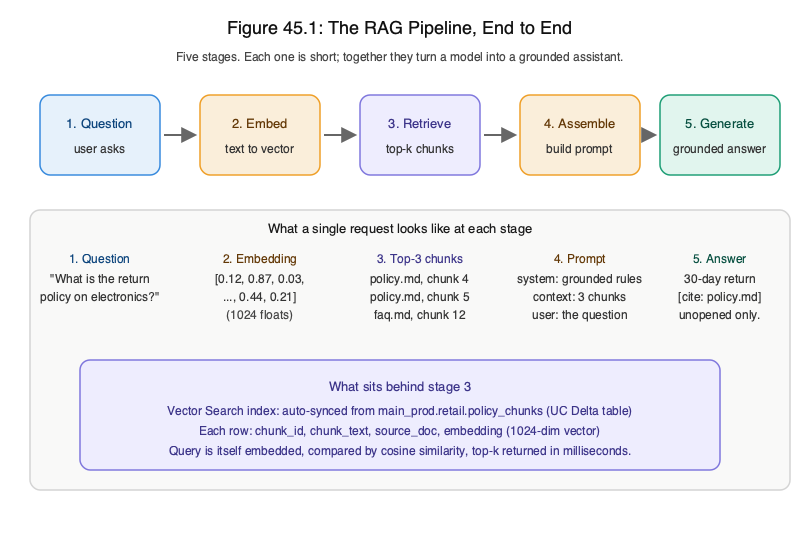
The architecture, in production-realistic terms
A working RAG system on Databricks has five components, each with its own failure modes:
- Ingestion and chunking, converting raw documents into retrieval-friendly units.
- Embedding generation, turning text chunks into vectors using a foundation model.
- Vector index, a queryable index over those vectors, kept in sync with the source data.
- Retrieval and re-ranking, finding relevant chunks for a given query.
- Generation, assembling a prompt and producing the final answer with an LLM.
Skip any of these and you have a demo, not a system. The book treats each as its own engineering discipline.
Chunking is where most teams underestimate the work
The fundamental tension in chunking: small chunks retrieve more precisely but lose context; large chunks preserve context but dilute relevance signal. Fixed-size chunking, the default in every tutorial, is rarely the right answer for production.
In practice, the chunking strategies that work in 2026 fall into four categories:
- Structure-aware, chunks follow document semantics: markdown headers, HTML sections, code blocks. Keeps related content together.
- Recursive, splits on hierarchical separators (paragraphs first, then sentences, then characters), preserving as much structure as the chunk size allows.
- Semantic, uses an embedding model to detect topical boundaries. More expensive at ingestion, often pays back in retrieval quality.
- Late chunking, embeds the full document, then chunks the embedding output. Preserves long-range context but requires support from the embedding model.
Pick a default, instrument retrieval evaluation, and iterate. Don't pick based on what reads well in a blog post.
Mosaic AI Vector Search is the right default, usually
For Databricks-resident data, Mosaic AI Vector Search is almost always the right vector store. It indexes directly from Delta tables, syncs automatically when source data changes, inherits Unity Catalog access controls, and runs in the same workspace as your generation models. The alternative, externalizing to Pinecone, Weaviate, or pgvector, adds an entire integration surface and a class of "the index is out of date" bugs.
Where external vector stores still win: extremely high QPS workloads where Databricks DBU cost becomes prohibitive, or hybrid stacks where the same vector index serves multiple non-Databricks consumers. The Vector Search topic guide covers the decision framework in detail.
Generation model selection matters less than you think
Once retrieval works, the choice of generation model becomes mostly a cost-vs-quality tradeoff. Databricks Foundation Model APIs give you access to DBRX, Llama, Mosaic models, and external providers (OpenAI, Anthropic, Cohere) through a single endpoint. You can A/B test models without rewriting the application.
The teams that win on quality spend their time on retrieval, not on model swaps. Better retrieval and a mid-tier generator usually beats worse retrieval and a frontier model.
Evaluation is what separates a working RAG from a shipped RAG
The single biggest gap between RAG demos and RAG products is the absence of evaluation. If you can't measure whether a prompt change makes things better or worse, you're guessing.
MLflow's evaluation tooling on Databricks ships with RAG-specific judges out of the box:
- Answer relevance, does the answer address the question?
- Faithfulness / groundedness, does the answer stay within the retrieved context?
- Context precision, how much of the retrieved context is relevant?
- Context recall, how much of the required information was retrieved?
- Safety, does the output avoid policy violations?
Build a curated evaluation set early, 50-200 representative question/expected-answer pairs is enough to start. Run it on every meaningful pipeline change. Track results in the MLflow experiment UI. The discipline of regression-testing a RAG system is the same discipline you'd apply to any other production code.
Tracing and observability, MLflow handles both
MLflow 3.0 added native LLM tracing, every retrieval, every model call, every tool invocation becomes a span. On Databricks, this gives you a single pane of glass for debugging "why did the answer say that?" Without tracing, RAG debugging is a nightmare; with it, root-causing a bad answer takes minutes instead of hours.
The MLflow topic guide goes deeper into the tracing model.
When RAG becomes an agent, and you should care
The line between "RAG system" and "agent" blurs quickly. The moment your system needs to decide what to retrieve, retrieve in multiple steps, call non-retrieval tools, or reflect on its own output, you have an agent. In 2026, the natural home for that on Databricks is AgentBricks.
The fast rule of thumb: if a single retrieval-and-generate pass solves the problem, stay with pure RAG. If you find yourself building retry logic, multi-step retrieval, or tool routing, promote it to an agent and use the right framework.
What the book covers, in detail
Databricks for Practitioners dedicates a full chapter to RAG. It includes:
- A reference Lakehouse-native ingestion pipeline with idempotent re-indexing.
- Four chunking strategies with evaluation results on three benchmark corpora.
- End-to-end retrieval evaluation harness using MLflow Evaluate.
- Cost analysis for embedding generation, index serving, and inference at three traffic levels.
- Production patterns: incremental indexing, document deletion, multi-tenant indexes, A/B testing retrieval strategies.
- The five most common failure modes and how to detect them in production.
The chapter assumes you can read Python and have an active Databricks workspace. It does not re-explain what a vector is.