Multi-Agent Systems on Databricks: When and How
Multi-agent is having a moment. The marketing makes it sound mandatory; the engineering reality is more conservative. This guide covers when multi-agent is actually the right answer, the patterns that work with the Databricks Multi-Agent Supervisor and MCP, and the failure modes that catch teams off guard.
Multi-agent systems are the trendy answer to "how do we make our agent smarter." Sometimes they're the right answer. Often they're a way of avoiding doing the harder work of designing a single agent well. This guide is a practitioner's view on when each is true.
Start with the single-agent question
Before adding a second agent, the right question is "can I make the first one better?" The levers on a single agent:
- Better tool descriptions.
- Better system prompt.
- Fewer, more focused tools.
- A re-ranker or filter in the retrieval pipeline.
- A stronger model.
A lot of "we need multi-agent" cases are actually "we have 47 tools and the agent can't pick the right one." The fix for that is tool pruning, not adding a router agent.
When multi-agent does pay off
Three cases where multi-agent is genuinely warranted:
- Genuinely distinct specializations. A planning agent that decides what to do, plus an execution agent that does it. Different prompts, different tool sets, different models. The boundaries are real, not invented.
- Tool count saturation. When a single agent has more tools than the model can reliably reason about, splitting tools across specialist agents recovers selection accuracy. The threshold is workload-dependent, but somewhere between 20 and 50 tools is typical.
- Parallel independent reasoning. When the task naturally decomposes into independent sub-tasks (analyze N documents in parallel), running them on parallel agent instances is faster than serial single-agent processing.
The supervisor pattern, the default that works
The supervisor pattern is the production default for a reason. It looks like this:
- The supervisor agent receives the user request.
- It decides which specialist agent(s) to invoke.
- Specialists run their work and return results.
- The supervisor aggregates and returns the final answer, or decides to invoke more specialists.
Why it works: the supervisor is the only agent with global state. Specialists are stateless from each other's perspective. Failure of a specialist is recoverable by the supervisor; failures don't cascade. Trace structure is predictable.
On AgentBricks, supervisors are implemented by composing agents, a specialist agent becomes a tool callable from the supervisor. The supervisor sees the specialist's tool name and description, calls it like any other tool, gets a structured response.
Peer-to-peer is rarely the right answer in production
Peer-to-peer agent systems, where agents talk directly to each other rather than through a supervisor, are flexible and powerful in research. They are also where the worst production failures happen: infinite message loops, runaway costs, deadlocks, cascading hallucinations.
The teams that succeed with peer patterns invest heavily in guardrails: maximum message count per session, cost budgets per invocation, timeout enforcement, structured message protocols. Most teams don't need this complexity. Start with supervisors; reach for peer only when you've proven you need to.
Tracing is non-negotiable
Single-agent traces are linear: a sequence of tool calls. Multi-agent traces are trees: the supervisor invokes specialists, specialists invoke tools, results flow back. Without tree-shaped tracing, debugging is brute-force.
On Databricks in 2026, MLflow Tracing handles multi-agent traces natively. Every span has a parent, every agent invocation is visible in the trace, every tool call is attributable to its caller. Open the trace in the MLflow UI to see the full execution tree.
Make this the default for every multi-agent system you build. The cost of not having traces is a 10x debugging tax forever.
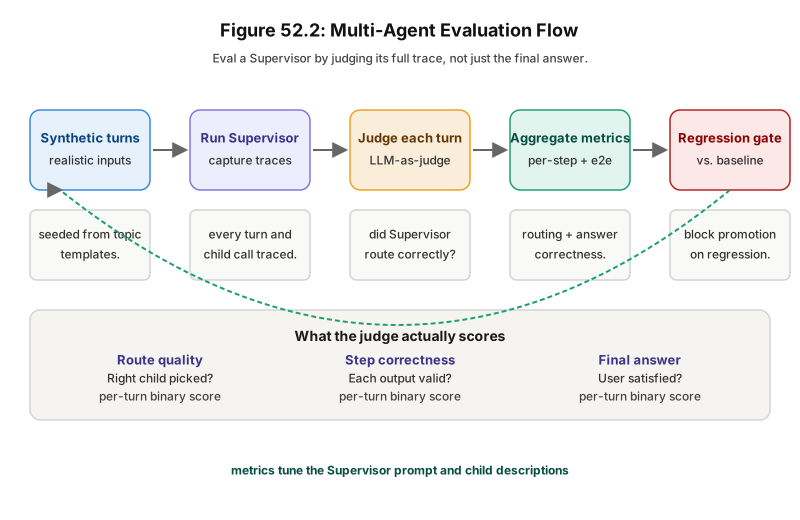
Evaluation: harder than single-agent
Single-agent evaluation has a reasonably clean signature: input → expected behavior. Multi-agent evaluation has more surface area:
- Did the supervisor pick the right specialist?
- Did each specialist do its job correctly?
- Did the supervisor synthesize the specialist outputs correctly?
A multi-agent system can produce a correct final answer through luck (one specialist's wrong answer happens to be cancelled by another). The eval set needs to include intermediate-state expectations, not just final-output expectations. Trajectory evaluation, not just end-state evaluation.
The cost trap
Multi-agent inference cost is the dominant production failure of multi-agent designs. A single user request that previously made one model call now makes 5–15. At scale, costs multiply accordingly.
Cost containment patterns:
- Hard caps on tokens per request, per session, per agent.
- Smaller models for specialists, frontier model only for the supervisor.
- Caching specialist outputs when inputs are repeated.
- Aggressive early termination, if the supervisor has a high-confidence answer after one specialist call, stop.
What the book covers
The multi-agent chapter in Databricks for Practitioners covers:
- The decision framework for single-agent vs multi-agent.
- A reference supervisor implementation on AgentBricks.
- Tool partitioning strategies for tool-saturated systems.
- Parallel agent execution for independent sub-tasks.
- Tracing and evaluation patterns specific to multi-agent.
- Cost models for multi-agent at three traffic tiers.
- Production failure modes, loops, runaways, deadlocks, and how to prevent them.